

HSE Public Consultation On The Reporting Of Injuries, Diseases and Dangerous Occurrences Regulations 2013
Consulation closes on 30th June 2026
Both the HSE and the existing regulations on reporting by employers of injuries and dangerous occurances and diseases in the workplace, is contentious for two reasons: the acuracy of employer's reporting, and the fact that the HSE accident and death statistics are based soleley on the premis that employer's are diligent in their reporting of such things. Further, the reporting of such workplace incidents is only necessary if the injury, disease, or dangerous occurance results in more than 7 consecutive days absence from work.
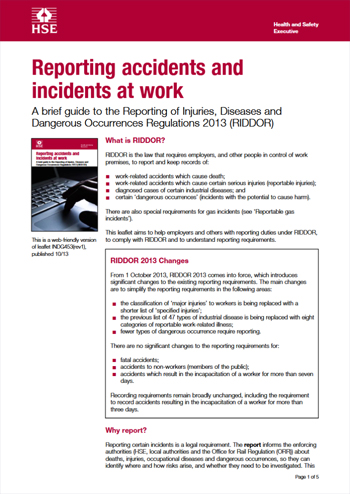 One glaring area of error made by employer's can be injuries and deaths to person travelling to work, or to person not in their workplace when an accdient occurs. Often these are automatically considered unreportable by the employer, but the fact is that it is not that simple, despite accidents not reportable under RIDDOR include commuting accidents (including those involving work-related travel).
So a straight forward example — an employee slips on a public pavement walking from the train station to the office — is not reportable under RIDDOR.
However, the key test is whether the accident arose "out of or in connection with work." When deciding if the accident that led to the death or injury is work-related, the key issues to consider are whether the accident was related to: the way the work was organised, carried out or supervised; any machinery, plant, substances, or equipment used for work; and the condition of the site or premises where the accident happened. If none of these factors are relevant to the incident, it is likely that a report will not be required.
So commuting itself isn't work, but the line can blur. For example, a member of staff going home and being hit and killed by a van making a delivery on site is reportable, because the van is undertaking a work activity. Similarly, a worker travelling for work (e.g. driving between client sites as part of their job) may well be in a reportable situation despite that "work-related travel" is also excluded under RIDDOR, the "arising out of or in connection with work" test can catch some travel scenarios.
However, in the case of a death resulting from a workplace incident, this MUST be reported irresepective of the time the person was absent from work prior to the death taking place.
For example: an injury takes place on a Monday, and the person returns to work on the Thursday. On the following Monday, the person dies from injuries sustained but not picked up at the time of the incident. Further, if the time between the incident and the death of the person involved, is anytinhg up to 12 months later, again, this must be recorded by the employer using the RIDDOR 2013 reporting procedures.
What Does RIDDOr Actually say in this regard?
All deaths of workers and non-workers arising from a work-related accident are reportable under RIDDOR. This also includes deaths that occur within one year following an accident at work, where this is the cause of death.
Regulation 6 requires the death of any person — worker or non-worker — to be reported if it arises from a work-related accident. The requirement extends beyond the day of the accident: if a worker dies within one year of a work-related injury, and that injury caused the death, a report is required even where an earlier RIDDOR report covered the original incident.
There's also an important additional point relevant to this scenario: Where the worker's injury or condition does not become apparent until some time after the accident, it must be reported as soon as it has prevented them from doing their normal work duties for more than 7 consecutive days. In this case, since the person died, the bar for reporting is obviously met.
Why the scenario might cause confusion:
The example seems to conflate the over-7-day incapacitation rule (which requires more than 7 consecutive days off work before a non-fatal injury is reportable) with the fatality reporting rule — but these are entirely separate obligations.
In circumstances where incapacitation or workplace injury doesn't appear after the incident, a RIDDOR report should be drafted upon the injury becoming known.
CWU Involvement in the consultation
 Jamie McGovern, National Health& Safety Policy Adviser for CWU, has responded to the consultation, by using the on-line method of response which is available from the HSE website consultations pages, and linked to at the end of this article.
The document ask for comments in addition to answerinf of the questions in each section of the document.
Perhaps one of the key areas of the HSE proposals relates to their definition of Injury vs Personal Injury, to which Jamie disagreed, commenting that the HSE's definition of "personal injury" under RIDDOR is a deliberate choice rather than a complete or accurate reflection of what personal injury truly means. By excluding psychological injury from its reporting requirements, the HSE has effectively narrowed the term to cover physical injuries only — yet it continues to use broader language that implies otherwise.
He continued:
To be transparent and accurate, RIDDOR should explicitly describe reportable injuries as personal physical injuries, making clear to the public that serious psychological harm sustained at work is not recognised as reportable under the current system.
As it stands, the terms "injury" and "personal injury" are ambiguous and misleading. "Personal injury" should by its very nature be an inclusive term — one that encompasses both physical and psychological harm. Under RIDDOR, it is not. The most serious work-related injuries, whether physical or psychological, are not treated equally, and the language used in the regulations should honestly reflect that disparity.
Agreeing that other definitions in the Regulations or associated guidance not included in the proposed list could be made clearer
Jamie responded, saying yes and explained that Under Regulation 6(1), the current wording requires reporting where a person dies "as a result of a work-related accident." We recommend that this be amended to read "work-related accident or event," supported by accompanying guidance that makes clear not all work-related deaths arise through conventional accident pathways.
Some workplace deaths result from unintended events that, while not accidents in the traditional sense, have a direct causal link to work activity — for example, deaths resulting from extreme weather events driven by climate change. The current wording fails to capture these scenarios, and both the Regulation and its guidance should be updated to reflect this broader reality.
These are just two of the key repsonses from Jamie, and an additional news item will explore in more detail, his response on behalf of the CWU to the consultation and the HSE proposals for changes to RIDDOR, will be explored.
The Consultation
Turning to the consultation itself, the HSE provides a document detailing RIDDOR and why the concultation is taking place:
The consultation aims to seek stakeholder views on the legislative and non-legislative proposals for
The Reporting of Injuries, Diseases and Dangerous Occurrences Regulations 2013 (RIDDOR) summarised below:
 Legislative
1. Clarify definitions in Regulation 2 of RIDDOR and associated guidance, where certain terms such as “work-related”, “injury” and “routine work” have been identified as unclear or ambiguous.
2. Revise the list of occupational diseases in Regulation 8 of RIDDOR by reintroducing some diseases that were previously on the list and adding new diseases to ensure serious instances of ill-health are captured.
3. Broaden the scope of accepted “diagnosis” in Regulation 2 of RIDDOR to allow the diagnosis of an occupational disease by other types of registered health practitioners, not just doctors who are registered and hold a license to practice with the General Medical Council (GMC).
4. Revise the list of dangerous occurrences in Schedule 2 of RIDDOR by adding new categories and amending existing ones to reflect modern risks.
Non-legislative
5. Improve the RIDDOR reporting process by simplifying the online form to reduce both under-reporting and over-reporting and improve overall usability.
Consultees are invited to respond to a number of questions for each proposal to support policy development and cost benefit assumptions.
This consultation is relevant to all sectors and industries – in particular duty holders, self-employed people and those in control of work premises. It is also relevant to associated professions, including health care practitioners. Certain proposals, however, may apply more specifically to particular roles than to others.
The HSE document to the right, is available to download from the Unionsafety E-Library, or by clicking on the image above right.
How to submit responses
Responses must be received by 30 June 2026.
Online survey
The easiest way to submit responses is by using the online survey
Source: HSE / CWU
